
Social Engineering Went Mainstream and Tavistock Was Already There
From the military to boardrooms, therapy, and rock icons, one institute shapes behaviour behind the scenes.

The following piece reflects my interpretation of material gathered across several decades of published writings, archived documents, online forums, recorded interviews, and institutional literature, including material released by the Tavistock Institute itself since its founding in 1947. I don’t present this as settled history or institutional fact. I present it as a critical synthesis of patterns, omissions, and recurring themes that emerge when official narratives are read alongside analysis and cultural response. Prefer audio? There’s an 18-minute narrative version waiting for you on YouTube in The Luminary Room. It’s called When Social Engineering Went Mainstream.
The Tavistock Institute of Human Relations presents itself as a modest “British research organisation studying group behaviour and organisational change”. It was established in London in 1947 by psychologists and psychiatrists with backgrounds in wartime psychological research and social science. It operates with programmes in organisational development, and consultancy work in mental health.
But beneath this institutional façade lies a much darker narrative. Tavistock was never merely an academic body. Instead, this institute pioneered methods of mass psychological influence that have shaped culture, corporate management, education, therapy, and even pop music for decades. My claim is that Tavistock didn’t merely study society, it engineered it.
Social Engineering Needed Architects and Eric Trist Supplied the Framework
The Tavistock Institute didn’t emerge without architects, and Eric Trist stands out as one of its most consequential. Trist was a psychologist and social scientist whose career centred on a single question: How do institutions shape human behaviour at scale? His work didn’t remain in lecture theatres, it moved directly into armies, factories, and management systems, where theory became applied practice.
During wartime Britain, Trist worked on improving how the army selected officers, replacing tradition and class with psychological assessment and group dynamics. This shift treated leadership as a behavioural construct that could be measured, trained, and optimised. The same logic followed him into post-war Britain through the Civil Resettlement Units, where social disruption was framed as a system failure rather than an individual one. People were not broken, environments were.
Trist later advanced what became known as socio-technical theory. Its premise was simple and disruptive. Organisations fail when they treat people as extensions of machines. They function when human behaviour and technical systems are designed together. On the surface, this reads as humane reform. Beneath it sits a far more consequential idea. Behaviour responds to structure. Change the structure and behaviour follows.
Trist didn’t argue for freedom from systems. He argued for better systems. He believed social scientists should actively redesign working life, management, and institutional organisation. In turbulent environments, he saw instability not as a threat but as a condition to be managed. Modern managers, facing constant disruption and uncertainty, still operate inside this framework.
Trist’s work provided a language and logic for cultural management rather than liberation. When behaviour becomes a design problem, autonomy becomes secondary to function, and when instability becomes normal, intervention becomes permanent. In this reading, Tavistock’s influence rests not on secrecy but on the quiet normalisation of psychological authority embedded into everyday life. And Trist matters here because he shows how social engineering didn’t arrive through force. It arrived through expertise.
The logic of influence that Trist outlined didn’t stop at factories, armies, or boardrooms. If behaviour responds to structure, then cultural institutions, media, and entertainment become natural labs for the same principles. Music, film, and pop culture can shape perception, identity, and social norms with the subtlety of expertise rather than the bluntness of coercion. The explosion of 1960s rock music provides a striking example. What happens when the very soundtrack of a generation is engineered to produce predictable shifts in attitudes, desires, and rebellion? What if the icons of youth culture were not only voices of freedom but instruments of carefully applied psychological strategy?
Were the Biggest Bands of the 60s the Voice of a Generation or the Tools of Hidden Hands?
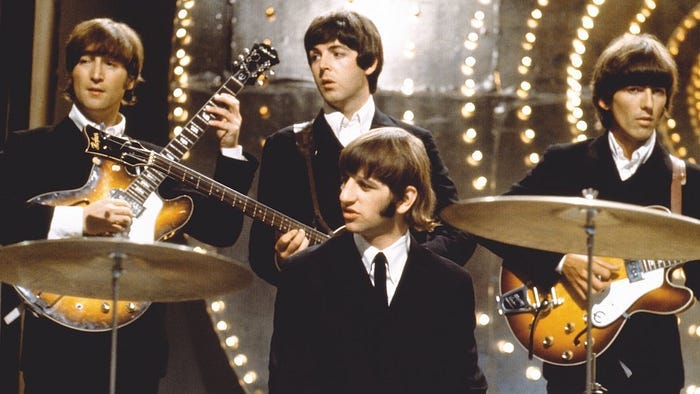
The story moves swiftly from organisational development into the realm of cultural programming when it reaches the 60s music scene. Rock bands like The Beatles, The Rolling Stones, Pink Floyd, and others were seen not as spontaneous cultural phenomena. Instead, these groups were portrayed as vehicles of a planned cultural shift. In this view, popular music became the vector for new attitudes toward authority, sexuality, drugs, and identity. According to several publicly-available accounts, rock music was not entertainment alone but a channel for reprogramming youth culture and dissolving traditional moral anchors.
But suspicion around pop music as a psychological force didn’t begin online. In 1965, Reverend David A. Noebel published “Communism, Hypnosis and The Beatles”, arguing that Beatlemania was not accidental. He compared the emotional response of teenage audiences to Ivan Pavlov’s conditioned reflex experiments and claimed that music functioned as behavioural conditioning rather than expression. His work was dismissed as alarmist, yet it captured an early fear that mass culture was shaping behaviour faster than institutions could acknowledge.
In the 70s, Lyndon LaRouche advanced a more explicit claim. He argued that The Beatles were linked to British intelligence interests and functioned as a form of psychological warfare directed at American culture. In his framing, cultural destabilisation weakened social cohesion, traditional authority, and moral restraint, all without firing a single shot. Music, in this view, succeeded where ideology failed.
That line of argument reached its most extreme articulation in 1991 when Dr. John Coleman, a former British intelligence officer, published claims asserting that the Tavistock Institute orchestrated the entire 60s counterculture movement. Coleman argued that Tavistock figures coordinated musicians, drug culture, and sexual permissiveness to fracture Western societies from within. He went further, claiming that German philosopher and musicologist Theodor Adorno helped shape popular music, including Beatles compositions, to carry hidden psychological cues.
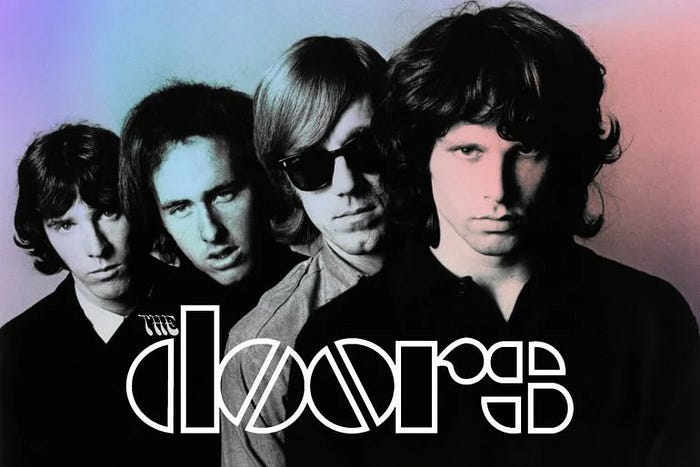
One detail often cited in this debate involves Jim Morrison. His father, George Stephen Morrison, was a U.S. Navy Rear Admiral who operated within the upper tiers of the American military during the Vietnam war and beyond. Such proximity to military and intelligence environments complicates the image of The Doors as pure countercultural outsiders. It begs the question whether rebellion that passes cleanly through media systems, record labels, and international promotion is rebellion at all.
Nevertheless, what matters is not whether every claim withstands scrutiny. What matters is why the pattern keeps returning. Why does popular music repeatedly surface in discussions of social conditioning, behavioural change, and generational rupture? Why did the language of rebellion arrive packaged, amplified, and monetised through corporate and media systems that rebellion supposedly opposed? If culture teaches people how to feel before it teaches them what to think, then music becomes more than art, it becomes influence.
If an organisation develops frameworks for understanding human relationships and group dynamics, what stops it from applying those frameworks beyond management training and corporate consultancy? This question matters because psychology and sociology measure influence. Theories of group behaviour are tools for interpreting society, and they’re also tools for shifting society, and the difference lies in how those tools are deployed.
Today, these same principles appear in social media algorithms, influencer networks, and digital content platforms. Companies and platforms manipulate attention, mood, and behaviour at scale using the very psychology of group response and engagement that institutions like Tavistock pioneered decades ago. Likes, trending topics, and recommendation feeds are modern labs for shaping collective behaviour, demonstrating that expertise in influence can migrate from the office or the factory floor into the virtual spaces where billions interact every day.
Several commentators draw a line from Tavistock’s wartime psychological operations to the cultural revolutions of the post-war era. During World War II, staff affiliated with Tavistock worked with military psychiatry and psychological warfare units. These efforts involved selecting officers, managing troop morale, and analysing group response to stress.
From there, theories assert that the methods developed in wartime became templates for peacetime influence. According to these narratives, Tavistock engineers believed that the social structures that stabilised communities, the family unit, religious practice, and traditional authority, made populations resistant to direction from above. To transform society, these stabilising forces had to be undermined.
Mainstream music and media essentially functioned as psychological triggers engineered to break down the social cohesion that once bound families and communities. Linguistic innovations and cultural concepts, such as the very idea of a “teenager” or “rock culture”, were strategic codes introduced to fragment established values and install new ones.
What does it mean if the most influential music of a generation was not merely popular but intentionally positioned to reshape emotional life and identity patterns? What does it mean if norms around rebellion, permissiveness, and self-expression were not emergent phenomena but orchestrated ones?
Shaping Minds Under the Guise of Growth
Moving beyond music, many researchers argue that Tavistock’s influence spread into education and organisational life. Concepts like “group therapy,” “encounter groups,” and “sensitivity training,” which emerged in mid-20th-century psychology, are portrayed as tools of mass conditioning rather than purely therapeutic techniques. In this framework, these practices serve to replace individual autonomy with collective identity and to normalise conformity under the guise of personal growth.
These claims also extend into corporate and institutional governance. According to publicly available documents and myriad narratives, Tavistock-rooted methodologies infiltrated business management, turning workplace culture into a cauldron for behaviour modification. The very language of corporate “culture,” “team cohesion,” and “psychological safety” is described by several researchers as borrowed from Tavistock-style group dynamics studies.
There’s also the idea that Tavistock’s network of ideas became a kind of engine for shaping global events. Wars, political upheavals, economic crises, and ideological movements are seen as not organic historical forces but manifestations of psychological strategies designed by elite planners. These planners are said to leverage crisis creation, media narratives, and behavioural science to engineer public compliance with policies that would otherwise be unacceptable.
Several theories also suggest that conflicts like the Cold War, the War on Drugs, and even the War on Terror are as much psychological operations as geopolitical struggles. They’re framed as mechanisms that transform populations from cohesive civic actors into fragmented, reactive groups. Divisions along cultural, racial, and economic lines are not seen as spontaneous social currents but as engineered outcomes that distract and weaken public agency.
A central thread in these arguments is the idea of crisis as a tool for influence.
According to several interpretations, Tavistock-inspired planners observed that people in crisis shift their behaviour dramatically. Faced with fear, uncertainty, or chaos, individuals are more likely to surrender autonomy to perceived authority, accept narratives without scrutiny, and adopt identities framed by outside sources. This pattern, seen in many social upheavals, becomes evidence of psychological strategy rather than random social change. I wrote about this at length in my essay Trauma-Based Mind Control and the Manufacturing of Obedience.
And here is where thought becomes challenging. Psychological science undeniably describes how groups form norms, how authority shapes behaviour, and how media influences perception. None of these principles are controversial in isolation. The controversy arises when one claims that such science has been systematically applied as mass social engineering by an institution like Tavistock. This is a leap from academic theory to intentional cultural transformation, and evidence is not well documented in the way mainstream historians require. Yet these theories persist because they resonate with people who sense underlying patterns in cultural histories.
Critics of these theories point out that Tavistock’s documented work lies in organisational consultancy, psychological research, and academic contributions. They assert that associating the institute with global mind control overstates its reach and understates the complexity of cultural evolution. Scholars outside this sphere see these narratives as projection, turning institutional influence into omnipotence without empirical proof.
But the questions still remain: Why does a narrative that ties together psychological research, media influence, and cultural change capture the imagination so strongly? Why do people instinctively link rock music, therapy culture, political movements, and corporate language into a single engineered arc? What if the patterns we observe are not mere coincidence but the result of overlapping influences from psychological theory, media economics, and shifting cultural norms?
These are questions worth confronting. They challenge us to examine how meaning is constructed in society and who steers that construction. They push us to scrutinise whether cultural change happens from the bottom up or whether it’s shaped by elites with access to the levers of psychology, media, and education.
Whether you view these claims as plausible or unfounded, the persistence of this narrative says something about our collective anxiety over who holds power in an interconnected world. It reveals a deep suspicion of institutions that are perceived to operate above public awareness. It highlights a broader struggle over narrative authority, autonomy, and the very notion of self-determination.
In the end, the real question is not whether The Tavistock Institute holds secret agendas. It’s why the idea resonates so widely and why so many people feel that cultural shifts have not been organic, but orchestrated.
Prefer audio? There’s an 18-minute narrative version waiting for you on YouTube in The Luminary Room. It’s called When Social Engineering Went Mainstream.
Nothing in this article demands belief. It asks for scrutiny. The interpretations offered above arise from reading institutional descriptions against critical literature, cultural outcomes, and the long memory of public distrust toward psychological authority exercised without democratic visibility. If these conclusions feel uncomfortable, that discomfort deserves examination rather than dismissal or accusatory commentary. This piece doesn’t claim final truth, but rather it claims the right to question why certain institutions shape behaviour, language, and norms while remaining largely absent from public interrogation. That tension, not certainty, is the whole point.
Additional References
Daniel Estulin’s “Tavistock Institute: Social Engineering the Masses”
An Ongoing Social Engineering Project to Mind Control Humanity
Nico,
For Gen X: We all lived in THE TRUMAN SHOW.
Our kids can't watch a movie without being on social media. Thoughts in 20 second clips....
And we had NO idea that we were completely engineered at that time. It's crazy!
True dat. From Elvis on. There is no way 4 20-somethings churned out all that music and media while playing shows. There was an army behind them. Bernard Purdie told me he played on the White Album. The Beatles were marketing reps for a social engineering initiative