



The silence is no longer tenable.
For years I watched from the sidelines as the digital landscape shifted from a tool for connection into an open-air vanity market - a relentless, flashing bazaar where everyone is selling a life they can’t afford, to people who can’t bear to watch.
It was precisely this unbearable culture of hyper-flexing - where corporate survival now demands weaponised vulnerability, performative grindset hustle, and curated self-congratulation - that ultimately drove me to cancel my LinkedIn account and seek greener pastures. But deleting an app doesn't stop the rot.
Look closely at Gen Z, the first true natives of this simulated reality, and you won’t just see a generation glued to screens. You’re watching a demographic being systematically farmed for its own self-doubt. Raised on highlight reels and calibrated by engagement algorithms, they’ve inherited a culture where worth is denominated in likes, and identity is outsourced to the highest bidder.
We’re watching a generation accelerate toward a quiet, self-inflicted collapse - trademarking their own psychological erosion for the sake of fleeting digital applause.
Social media didn’t just capture our attention. It colonised our insecurities, packaged our envy, and turned our deepest vulnerabilities into a recurring subscription model.
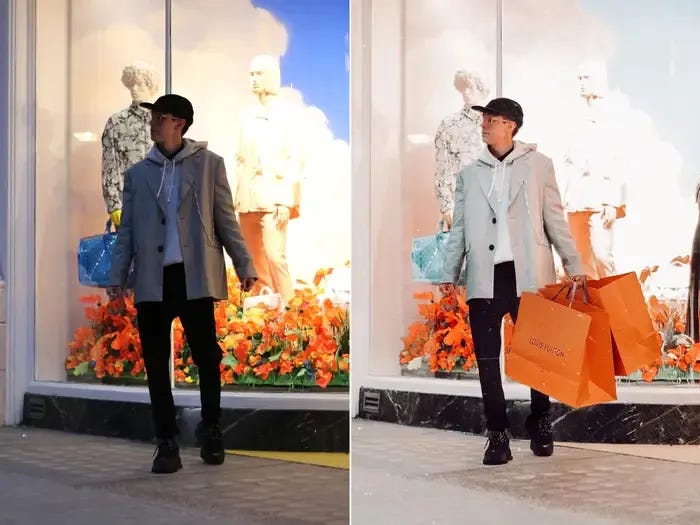
Picture this: It’s a Tuesday afternoon, and someone you follow posts a selfie on a snow-capped mountain beside a helicopter. Hours later, they’re sipping champagne in a rooftop infinity pool with a skyline view. Swipe once: lobster tower. Swipe again: Balenciaga shopping haul. The caption? “Work hard, play harder.”
Scroll, compare, repeat.
This is what’s referred to as the social media flex. Given, it’s not new but it’s become more polished, more frequent, more strategically curated. And it’s rarely just about sharing. It’s a psychological performance designed to signal status, manufacture envy, and chase a fleeting rush. But behind the aesthetics lies a set of deeper, more troubling human instincts, and a digital ecosystem built to exploit them.
Why They Flex: The Psychology Behind the Show
Social media didn’t invent the need to show off. But it amplified it, accelerated it, and monetised it. To understand why people flex, why they feel compelled to display wealth, luxury, and status, we need to look at three interlocking psychological systems that social platforms deliberately trigger: the dopamine feedback loop, social comparison, and identity signalling.
1. Dopamine Feedback Loops: Addictive Validation by Design
Human behaviour is shaped by rewards. When a behaviour delivers a pleasurable outcome, we’re more likely to repeat it. This is basic operant conditioning. On social media, that reward often comes in the form of “likes,” comments, shares, or even envy-laced DMs. These aren’t neutral interactions. Each one triggers a dopamine hit, a chemical signal associated with pleasure, anticipation, and reinforcement.
This mechanism is core to how platforms engineer engagement.
Former Facebook executive Chamath Palihapitiya made this explicit in a 2017 talk at Stanford:
“The short-term, dopamine-driven feedback loops that we have created are destroying how society works… [Social media is] ripping apart the social fabric.”
Flexing, whether it’s posting designer labels or a $800 dinner, is high-reward content. It’s provocative, aspirational, and algorithmically favoured. It invites rapid engagement, which reinforces the behaviour and primes the user to repeat it. The loop is closed when others, feeling behind, try to match or exceed what they see. The platform thrives on this escalation.
And this isn’t just speculation.
A 2024 study in Psychological Science found that virality predicts moral outrage in tweets, even when controlling for content, showing that emotionally intense posts are more likely to spread, regardless of accuracy or helpfulness.
This is echoed by a 2025 study in Nature Scientific Reports, which found that high-arousal emotional content, whether outrage, admiration, or fear, was significantly more likely to be shared. Algorithms don’t reward balance; they reward reaction.
2. Social Comparison: Scrolling as Self-Assessment
Psychologist Leon Festinger’s theory of social comparison suggests that people evaluate their own worth by comparing themselves to others, especially when objective measures are lacking. On social media, this comparison is continuous, hyper-curated, and largely upward.
Enjoying this read? Consider pledging an amount that feels right to you. Your support keeps independent investigative research - and the search for truth - alive.
You’re not just seeing what your peers are doing. You’re seeing highlight reels: filtered, edited, staged. According to an April 2025 survey by Pew Research Center, over half of teenagers reported feeling that others are doing “better” than them after using social media, and that roughly 1 in 5 said social media sites hurt their mental health, and growing shares think they harm people their age.
The “flex” takes advantage of this psychological sensitivity. When someone posts their five-star hotel suite or their haul from Dolce e Gabbana, it creates a standard that others feel they must meet, or at least appear to meet. This breeds a performance spiral. Even those who don’t normally post feel pressure to showcase something that validates their worth.
Social media transforms the act of looking into a silent competition.
A 2021 meta-review published in Cyberpsychology, Behaviour, and Social Networking found a significant link between time spent on image-centric platforms (like TikTok and Instagram) and increased levels of anxiety, body dissatisfaction, and depressive symptoms.
As I’ve previously published regarding the architecture of digital exploitation - such as the calculated mechanisms of the online adult entertainment cartels designed to commodify human degradation - the mechanics of mass psychological manipulation always rely on a rigged baseline. It’s an asymmetric warfare waged against our biology.
It’s not just what we see. It’s what we infer about our inadequacy. And it’s not a fair fight. Comparing someone’s algorithmically boosted peak to your everyday life is a guaranteed psychological trap. Whether it’s the hyper-commercialised fantasy of physical perfection or the frictionless, chartered-jet aesthetics of the modern influencer, the digital ecosystem relies on the same core vector: weaponising our natural propensity for comparison, and converting our self-doubt into raw corporate profit.
3. Identity Signalling: Who Are You Online?
Beyond reward and comparison, there’s another force at play: identity construction. Social media encourages users not just to share who they are, but to construct who they want to be seen as.
This is what psychologists call costly signalling: behaviours or displays that communicate high status because they’re difficult to fake or replicate.
In evolutionary terms, peacocks do this with tails. Gen Z now does it with a limited-edition sneaker drop and a minimalist bookcase filled with theory.
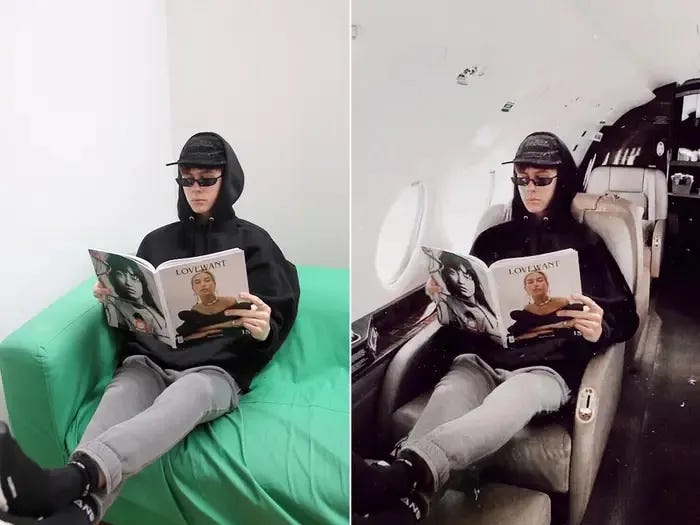
Posting luxury items, gourmet meals, or elite experiences like premium air travel is often a way to signal taste, wealth, discipline, or success. These signals are strategic: they convey membership in certain aspirational groups. Think of the visual codes: private jet interiors or a first class seat on a long-haul flight, minimalist hotel rooms, plates with microgreens instead of food. These aren’t just photos. They’re identity markers.
Sociologist Erving Goffman described life as a series of performances: we present different selves depending on audience and context. Social media collapses all audiences into one screen, forcing users into increasingly stylised performances.
And this has real psychological consequences.
A 2019 study in Journal of Consumer Research found that people who frequently engaged in identity-based posting experienced higher levels of social pressure and identity fragmentation, feeling that their real selves were becoming disconnected from their online personas.
Over time, this disconnect erodes authenticity. The person curating luxury posts may be deeply insecure, deeply in debt, or both. But the algorithm doesn’t care. It rewards the signal, not the substance.
How to Recognise a Flex in the Wild
Not all flexing looks like a Pagani and a Richard Mille on your wrist. Here are subtler forms of digital status signalling that flood your feed (chances are, your LinkedIn timeline is already reeking of them):
“Humble” Brag: “Can’t believe I made the Forbes 30 Under 30 list. So grateful.”
Luxury-as-Minimalism: A white bathrobe, an espresso, ocean in the background, no caption needed.
Inaccessible Wellness: Morning routine posts involving infrared saunas, cold plunges, and adaptogen stacks.
Scarcity Flex: Concert tickets, sold-out launches, private invites, signalling access, not experience.
Work Hard, Flex Harder: “Just landed. Quick 12 hours in Dubai for meetings. Back tomorrow.”
Earned Indulgence: Posts that imply the reward is deserved: “After 80-hour weeks, I finally booked that Maldives trip.”
The common denominator? An implicit message: I’m winning. Are you?
The Bigger Picture
This isn’t just about showing off.
It’s about what we value, what we chase, and what we lose.
Psychologists are documenting rising rates of anxiety, depression, and loneliness, particularly among younger users immersed in social comparison from adolescence. Political scientists note the polarisation effects of algorithmic echo chambers. Parents report behavioural changes in children tied to screen time and validation-seeking.
Meanwhile, entire industries, from luxury goods and influencer marketing to “aspirational” travel, are built on users flexing and others reacting.
But at what cost?
Questions Worth Asking
Is the dopamine hit really worth the social cost?
What happens when real relationships feel less rewarding than digital applause?
What kind of person are we becoming when our best moments are packaged not for memory, but for consumption?
And perhaps most critically: What would social media look like if it were designed not to exploit our insecurities, but to support our wellbeing?
Real value doesn’t need a filter. But do we still know what it looks like?
Comparison is the thief of joy 🌷
I am so glad that I grew up in a home in the era of no telephone (initially) and no television; and being turfed outdoors, along with all the other kids in the neighbourhood, to amuse ourselves.