


In my previous consumer product exposé on chocolate (refer below), I pulled back the curtain on how major global confectioners quietly gutted their original recipes - slashing real cacao butter down to bare minimums and swapping it for cheap, industrial palm oil to widen corporate profit margins.

For new readers joining this publication: my objective here is simple. Having spent close to two decades inside the advertising industry looking behind the curtain, I learned first-hand how brand perception is manufactured and how corporate narratives are spun. I now use that insider knowledge to conduct deep-dive investigative breakdowns into corporate brands that lie to consumers for raw financial greed.
When you track the parent companies behind these household names - whether it’s mega-conglomerates like Procter & Gamble, Colgate-Palmolive, Unilever, or Haleon - you inevitably find the same institutional mega-shareholders holding the dominant stakes: BlackRock, Vanguard, and State Street. When maximising quarterly return for institutional asset managers is the sole mandate, product integrity and human health take a back seat every single time.
Today, I’m turning my focus from the confectionery aisle to the oral hygiene aisle.
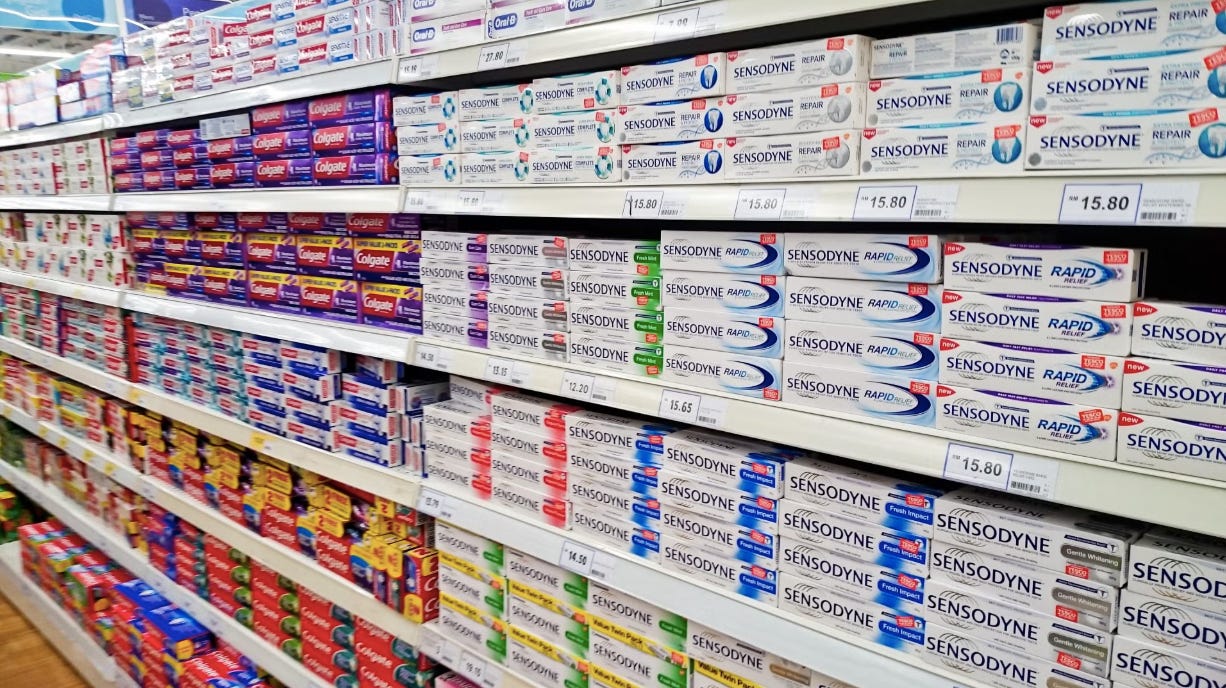
Walk into the toothpaste aisle of any major retailer - whether you’re browsing the shelves at Walmart, Target, CVS, or Kroger in the US; Shoppers Drug Mart, Loblaws, Rexall, or Walmart in Canada; Boots, Superdrug, Tesco, or Sainsbury’s in the UK; or Chemist Warehouse, Coles, Woolworths, or Priceline in Australia - and you’re surrounded by dozens of colourful, shiny boxes promising healthy enamel, whiter teeth, and complete protection.
But look past the slick marketing and read the ingredient labels on these mass-market lines, and a very different picture emerges.
Most people don’t realise that teeth are capable of a natural, ongoing biological process called remineralisation.
What Is Remineralisation and How Does Saliva Heal Your Teeth?
Your enamel is constantly exposed to acids from food, drink, and plaque bacteria, which strip away essential building-block minerals like calcium and phosphate (a process called demineralisation).
Fortunately, your body has a built-in defence mechanism: saliva. Saliva is packed with bioavailable calcium and phosphate ions, serving as a natural buffering bath that neutralises oral acids and delivers those minerals straight back into the microscopic pores of your tooth enamel. Given the right nutritional environment and optimal saliva flow, this natural process can actually repair micro-lesions and heal early-stage cavities before they ever turn into full-blown decay.
The Remineralisation Blocker: Glycerine
The primary culprit lurking at the very top of almost every major toothpaste label is glycerine (or glycerin). Glycerine acts as an inexpensive humectant to give toothpaste its smooth texture and keep it from drying out in the tube. However, it leaves a slick, microscopic coating over the enamel. This invisible layer acts like a waterproof barrier, preventing your saliva and its vital mineral bath from actually making contact with the teeth - effectively halting natural remineralisation in its tracks.
When you scan global supermarket shelves, virtually every major household brand relies on glycerine as a foundational base ingredient in their mass-market formulas:
Sensodyne (Global): The Promise: “Relief from tooth sensitivity and long-lasting protection.”
Colgate (Global): The Promise: “All-day cavity protection and stronger, whiter teeth.”
Crest (US/Canada): The Promise: “3D White brilliance and complete enamel health.”
Arm & Hammer (Global): The Promise: “Harnessing natural baking soda for deep cleaning and plaque defence.”
Tom’s of Maine (US/Canada): The Promise: “Natural, healthy oral care made with clean ingredients.”
Hello (Global): The Promise: “Thoughtfully crafted, friendly toothpaste with no artificial preservatives.”
Oral-B (UK/Australia/Europe): The Promise: “Pro-expert protection designed by dentists to rebuild enamel.”
Aquafresh (UK/Global): The Promise: “Triple-protection for strong teeth, healthy gums, and fresh breath.”
Macleans (UK/Australia): The Promise: “Family dental health protection against plaque and decay.”
Signal / Pepsodent (UK/Europe): The Promise: “Fights decay and strengthens teeth for long-term health.”
Close-Up (US/Global): The Promise: “Deep-action freshness and a bright, confident smile.”
AIM (US): The Promise: “Multi-benefit anti-cavity protection at an everyday value.”
The Fluoride Deception: Industrial Waste Repackaged as Oral Healthcare
When a brand skips glycerine, it invariably leans into fluoride as its primary heroic selling point. But looking into the actual supply chain behind commercial fluoride reveals a stark reality: it’s not a rare, pristine mineral harvested for human health.
Mass-market oral care and water treatment rely heavily on synthetic silicofluorides (such as hydrofluorosilicic acid or sodium fluoride) - chemical byproducts captured from the wet scrubbers of the industrial phosphate fertiliser and aluminium manufacturing industries. What would otherwise be classified as toxic, highly regulated environmental waste requiring expensive industrial containment is instead bought, processed, and packaged into tubes sitting on supermarket shelves.
Beyond Enamel: Fluoride and Pineal Gland Calcification
While we’ve been sold the lie that fluoride hardens enamel by converting hydroxyapatite into fluorapatite, systemic absorption tells a very different biological story.
Fluoride has a powerful affinity for calcium-rich tissues. Beyond accumulating in bones, research shows that fluoride concentrates heavily in the pineal gland - a vital endocrine organ located near the centre of the brain responsible for regulating circadian rhythms, production of melatonin, and deeper hormonal balance.
Because the pineal gland sits outside the blood-brain barrier and handles significant blood flow, it acts like a magnet for circulating fluoride ions. Over time, these fluoride deposits accelerate the calcification of the pineal gland, turning soft functional tissue into hard calcium-phosphate crystals.
The result? Suppressed natural melatonin output, disrupted sleep architecture, and the long-term degradation of an essential neurological center - all for the sake of a superficial chemical coating that ignores the root causes of tooth decay.
The Alternatives Aren’t Doing You Any Favours
Even when you go looking for niche options or toothpastes that try to skip glycerine, the mass-market alternatives present their own severe drawbacks. They rely on ingredients that carry significant health concerns:
AIM: Skips the heavy glycerine base, but relies heavily on synthetic fluoride. While marketed as the ultimate anti-cavity hero, fluoride chemically alters the natural hydroxyapatite matrix of your teeth into fluorapatite. While fluorapatite hardens the outer surface, it doesn’t truly rebuild missing enamel structure the way natural calcium and phosphate do.
Furthermore, systemic fluoride absorption is linked to the calcification of the pineal gland over time.
Close-Up: Avoids glycerine, but packs its gel with synthetic dyes like Red 33 and Red 40. Red 40 - a petroleum-derived dye under heavy regulatory scrutiny and targeted for phase-out initiatives in ingested products due to links to hyperactivity and gut inflammation - adds zero oral health value while exposing consumers to unnecessary chemical dyes alongside sodium fluoride.
Jason Simply Natural / Powersmile: Often marketed in natural aisles as “free from harsh chemicals,” yet relies on synthetic fluoride derivatives alongside heavy foaming agents like Sodium Lauryl Sulfate (SLS) or synthetic binders that agitate delicate oral tissue.
Burt’s Bees Natural Toothpaste: Promoted as a “clean” alternative, but relies on fluoride and thickeners that mimic the coating action of glycerine, offering no real advantage for natural remineralisation.
Desert Essence: Marketed to wellness-minded shoppers, but many SKUs incorporate glycerine alongside harsh abrasive cleansers that strip enamel while leaving a coating behind anyway.
Clean Oral Care: 5 Glycerine-Free & Fluoride-Free Brands
(Note: These represent 5 specific clean brands I have individually investigated and verified based on current formulations, but other glycerine-free, fluoride-free alternatives may exist on the market.)
If you want to support your body’s natural remineralisation process without coating your enamel in glycerine or exposing yourself to fluoride, you have to look outside big-box retailers. Here are 5 clean brands that use non-coating bases and utilise biomimetic Hydroxyapatite (HAp) - the exact mineral your teeth are naturally made of:
RiseWell (Mineral Toothpaste): Uses micro-hydroxyapatite to naturally rebuild enamel alongside xylitol, with zero glycerine or fluoride.
Boka (Ela Mint): Formulated with Nano-Hydroxyapatite (nHAp) to close dentin tubules and remineralise enamel without synthetic additives.
Primal Life Organics (Dirty Mouth Toothpowder): A completely glycerine-free, powdered formula made with mineral-rich clays, baking soda, and essential oils that allow saliva full access to enamel.
Uncle Harry’s Natural Toothpaste: Built on a mineralising clay and colloidal silver base; completely free of glycerine, synthetic dyes, and fluoride.
Living Libations (Frankincense Fresh Toothpaste / Toothpowder): Features natural chalk, clay, and pure botanical extracts to clean teeth without leaving a synthetic film behind.
The Bottom Line
The major brands occupying 95% of the shelf space in supermarket oral care aisles around the world are fundamentally built on formulas that either coat the teeth to prevent natural repair or introduce unnecessary synthetic chemicals.
Every tube of mass-market toothpaste sitting on supermarket shelves represents a calculated decision to prioritise manufacturing margins over human biology.
The most effective action we can as consumers take is immediate refusal. Stop funding conglomerates that coat your teeth in industrial by-products. Walk away from the big-box oral care aisle, starve their quarterly margins, and force these corporate crime syndicates to answer to an informed public.
When fifty variants of the same chemical formulation hijack fifty feet of store shelf, it isn't consumer choice - it's market dominance disguised as variety. Perhaps the bigger question isn't why these ingredients are in our toothpaste, but why we need so many brands to lie to us in the first place.
BIOMED toothpaste is what I use... no nasties and herbal with hydroxyapatite and l-arginine. Comes in various 'flavours' Fairly cheap at about £6 a tube or you can get specials on Amazon every so often and buy 3 tubes for 9.99! - I also whack a drop or two of organic caster oil on my brush a few times a week for added gum health after the main brush just before rinsing and I try to rinse with filtered water not tap water...
I make my own toothpaste - literally takes 5 minutes to make 6 months worth.
cocconut butter, bicarb and bentonite clay with a few drops of peppermint oil. done.